Electric Vehicle Batteries Mechanics, Chemistry, and Lifespan Factors
Electric Vehicles
|
May 20, 2026
Electric vehicle (EV) batteries serve as the essential power source for electric cars, enabling them to function effectively by storing energy that powers the vehicle's electric motor. Unlike traditional vehicles that run on gasoline, EVs depend entirely on these batteries for propulsion, highlighting their critical role in both performance and range. A vital factor to assess when considering an EV battery is its kilowatt-hour (kWh) capacity, representing the amount of energy the battery can store. Batteries with higher kWh ratings allow for longer driving distances on a single charge, directly influencing an EV’s practicality in everyday scenarios. Grasping these foundational concepts facilitates a deeper understanding of the intricate mechanics and chemistry involved in EV batteries.
1. What is an EV Traction Battery?
EV traction batteries are fundamental for vehicle propulsion, as they store and release power to the electric motor. These batteries convert the stored chemical energy into electrical energy, thus driving the motor and propelling the vehicle forward. The capacity, represented in kilowatt-hours (kWh), is directly related to the energy available for propulsion, and understanding this measurement is essential for consumers who want to gauge their vehicle's potential range. A larger kWh rating often indicates that the vehicle can travel farther on a single charge, providing peace of mind for those worried about charging options during their journeys. Therefore, traction batteries play a dual role: powering the vehicle while significantly enhancing the overall ownership experience by determining how far a driver can travel between charges.
2. How Electric Vehicle Batteries Work
Understanding the components of an EV battery is crucial for anyone interested in electric vehicles.
2.1 Cells
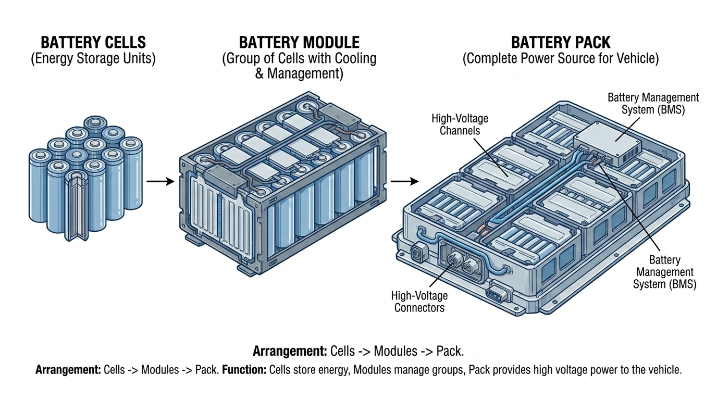
At the heart of an EV battery lie individual cells, often based on lithium-ion technology, that generate electricity through electrochemical reactions. Each cell is comprised of electrodes—the positive cathode and the negative anode—immersed within an electrolyte solution. The configuration of these cells dictates the voltage and capacity of the battery, establishing a foundation for the EV’s performance.
2.2 Modules and Packs
Cells are combined into modules, with each module consisting of several interconnected cells that form a unit designed for optimal balance between capacity and safety. These modules are then assembled into larger battery packs, which consolidate multiple modules, optimizing space and enhancing energy density for efficient power delivery to the vehicle.
2.3 Battery Management Systems
An integral element of battery functionality is the Battery Management System (BMS). This system leverages software and hardware to continuously monitor each cell's performance, ensuring they operate within safe limits. The BMS tracks essential parameters like voltage, temperature, and current flow, optimizing charging and discharging cycles and protecting the battery from potential damage, ultimately enhancing both longevity and performance.
2.4 Thermal Management
Temperature regulation is vital for ensuring battery performance and longevity. EV batteries work best within specific thermal ranges; therefore, the thermal management system employs various cooling or heating techniques to maintain these optimal conditions. This prevents overheating during rigorous use and mitigates performance issues in colder climates, safeguarding the battery's health and efficiency.
2.5 State of Charge
The State of Charge (SOC) denotes the current energy level of the battery compared to its total capacity, akin to a traditional vehicle's fuel gauge. Keeping track of SOC is essential for effective battery use, impacting driving range estimates and ensuring that charging occurs at optimal times which prevents overcharging or excessively deep discharging that could harm the battery's integrity.
2.6 Usable vs. Gross Capacity
Understanding the differentiation between usable and gross capacity is essential for effective battery management. Gross capacity represents the total energy stored in a battery, while usable capacity is the portion that can be safely utilized without jeopardizing battery health. Knowledge of this distinction enables users to better estimate their vehicle range and manage charging schedules effectively, directly contributing to longer battery life.
3. Comparing EV Battery Chemistries
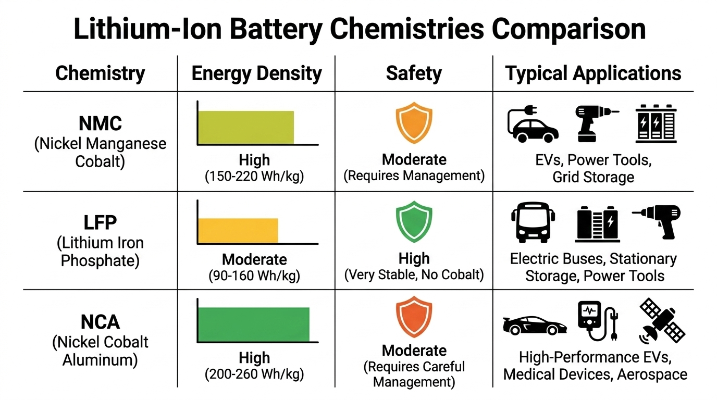
In the realm of electric vehicle (EV) batteries, three commonly referenced lithium-ion chemistries are Nickel Manganese Cobalt (NMC), Lithium Iron Phosphate (LFP), and Nickel Cobalt Aluminum (NCA). Each of these chemistries displays unique attributes that suit various applications.
NMC batteries blend nickel, manganese, and cobalt to offer a balanced performance in energy density, stability, and thermal management. Although their versatility makes them a prevalent choice in the EV industry, the dependence on cobalt raises ethical concerns and supply chain complexities. Conversely, LFP batteries are recognized for enhanced thermal stability, safety, and longevity, though they tend to have lower energy density, resulting in reduced range compared to their NMC or NCA counterparts. Their robustness and affordability make them ideal for instances where safety is a priority. NCA batteries excel in terms of energy density and performance, often favored for high-performance vehicle applications. Nevertheless, their complexity and cobalt reliance can pose potential drawbacks. In summary, the decision to opt for NMC, LFP, or NCA largely hinges on the specific needs and strategic priorities of the application, thereby illuminating the diverse landscape of battery technologies.
4. EV Battery Performance: Range, Efficiency, and Charging Explained
Numerous aspects significantly impact the real-world range of electric vehicles (EVs). Firstly, battery size is crucial; larger batteries yield more energy, thereby extending the range. However, the synergy between vehicle efficiency and battery size is vital. A smaller, more efficiently designed EV might outperform a larger one with lesser energy efficiency.
Additionally, weather conditions have a significant role; cold temperatures can adversely affect battery performance, limiting range, while excessive heat can exacerbate battery degradation. Thus, an EV owner in a colder region might face reduced range compared to one residing in a milder climate.
Moreover, factors such as driving speed and the use of accessories like air conditioning or heating can severely impact battery consumption rates, where high speeds often lead to faster battery drain and reduced range.
Regarding charging dynamics, a delicate balance exists between battery capacity and charging speed. While rapid charging can be expedient, it might compromise battery health over time, leading to a necessity for a holistic strategy in managing both range and battery longevity effectively. For daily EV usage, comprehending these elements enables drivers to plan routes and charging schedules better, optimizing their overall driving experience.
5. EV Battery Longevity and Long-Term Performance
Battery degradation refers to the gradual decline in capacity and performance of electric vehicle (EV) batteries over time. For EV owners, this translates to a decrease in the total range and efficiency of their vehicles, which might necessitate more frequent charging and could potentially lead to costly battery replacements. One significant contributor to accelerated battery degradation is the practice of fast charging. Although convenient, fast charging generates considerable heat and imposes additional stress on battery components.
Extreme temperature conditions—both high and low—exist as further adversaries to battery lifespan. Excessive heat can induce electrolyte breakdown and amplify internal resistance, while frigid temperatures can limit power availability and interfere with charging cycles. Many EV owners face these challenges, especially those reliant on fast charging stations or residing in areas that experience extreme weather.
To combat degradation, proper maintenance routines and prudent charging habits are crucial. Keeping a steady state of charge between 20% and 80%, preventing prolonged exposure to extreme heat, and minimizing frequent fast charging can vastly extend battery life. Engaging in these practices can allow EV owners to optimize their vehicles and tackle the challenges associated with battery care more effectively.
6. EV Battery Safety and Thermal Management
Electric vehicle (EV) batteries incorporate numerous safety mechanisms designed to enhance user protection and improve performance. A vital element is the battery management system (BMS), which continuously supervises voltage, temperature, and current to avert instances of overcharging and overheating. In addition, many EV batteries employ thermal sensors and cooling systems that help maintain ideal operating temperatures, ensuring cells stay within safe operational limits.
Maintaining effective thermal management is paramount in preventing potential failures and prolonging battery life. By actively regulating temperature, EV manufacturers can minimize the risks associated with thermal runaway—a perilous condition that can lead to fires or battery degradation. Innovations in cooling technologies, including liquid cooling systems or phase change materials, play a critical role in heat management. These advancements not only significantly bolster safety but also augment overall vehicle performance, providing assurance to consumers regarding the reliability of EVs and their inherent battery systems.
7. EV Battery Warranty, Maintenance, and Recycling
Typical warranty terms for electric vehicle (EV) batteries span from 8 to 10 years or 100,000 to 150,000 miles, differing among manufacturers. These warranties typically cover material defects and workmanship issues, occasionally guaranteeing a minimum capacity retention—often around 70% of the original capacity within a designated time frame. For EV owners, grasping details regarding options for repair, reuse, and recycling becomes essential for comprehensive battery lifecycle management. Repairs for battery-related issues may be complex but are often encompassed within warranty coverage.
The concept of reuse may involve repurposing batteries for home storage applications, while recycling practices ensure valuable materials, such as lithium and cobalt, are reclaimed safely. To optimize your investment, it’s prudent to examine detailed warranty coverage, consult qualified professionals for potential repairs, and proactively pursue recycling avenues at the end of a battery’s operational life.
8. EV Buyer Checklist: What to Consider Before Buying
Purchasing an electric vehicle (EV) warrants a careful evaluation of several key aspects:
- Warranty: Fully understand the warranty details concerning both the battery and drivetrain. Key questions include: What specific aspects does the warranty cover? What is its duration, and what conditions apply?
- Safety: Investigate safety ratings and features by asking: What safety tests has the EV undergone? Are any safety concerns noted regarding the battery?
- Longevity: Explore elements influencing battery lifespan. Importance lies in asking: What is the expected battery lifespan, and how do driving behaviors and charging habits affect it?
- Performance Claims: Validate manufacturer specifications by inquiring: How do real-world conditions influence range and performance? Can I access independent testing data? Taking this checklist into account enables potential buyers to make informed decisions and feel confident about their EV selection.
Making Informed EV Battery Decisions
Understanding EV battery technology can help consumers make better decisions when choosing an electric vehicle. Factors such as battery chemistry, driving range, charging performance, durability, and warranty coverage all influence the long-term ownership experience.
As EV technology continues to improve, newer battery systems are expected to provide better efficiency, reliability, and sustainability. By considering both current capabilities and future developments, buyers can select electric vehicles that better match their driving needs and long-term expectations.
Related Posts
Why In-Car Charging Solutions Matter More Than Ever

5 New Cars Under $30K That Actually Beat Luxury Models in 2026

How To Choose a Car Phone Holder That Won't Fall Off on Rough Roads
Toyota Camry 2026 vs Honda Accord 2026 Which Midsize Sedan Is the Better Buy

The Best New Cars for Business Owners in 2026 Smart Picks That Work as Hard as You Do